Energy awareness is often discussed in big terms—data centers, grids, and industry. But daily habits matter too, including the small "always-on" screens that quietly draw power on desks and in offices. As part of a series of simple experiments focused on sustainability and low energy use, this project explores a calmer way to stay informed about cybersecurity: an e-ink briefing display that updates periodically and otherwise rests in a low-power state.
The Hardware: Seeed Studio reTerminal E1002
The dashboard is built on a Seeed Studio reTerminal E1002, which combines an ESP32-S3 microcontroller with an e-ink display. This compact device shows a snapshot of critical security information:
- Recent items from CISA's Known Exploited Vulnerabilities (KEV) catalog
- A short list of security news headlines
- A minimal status line showing last update time and battery state
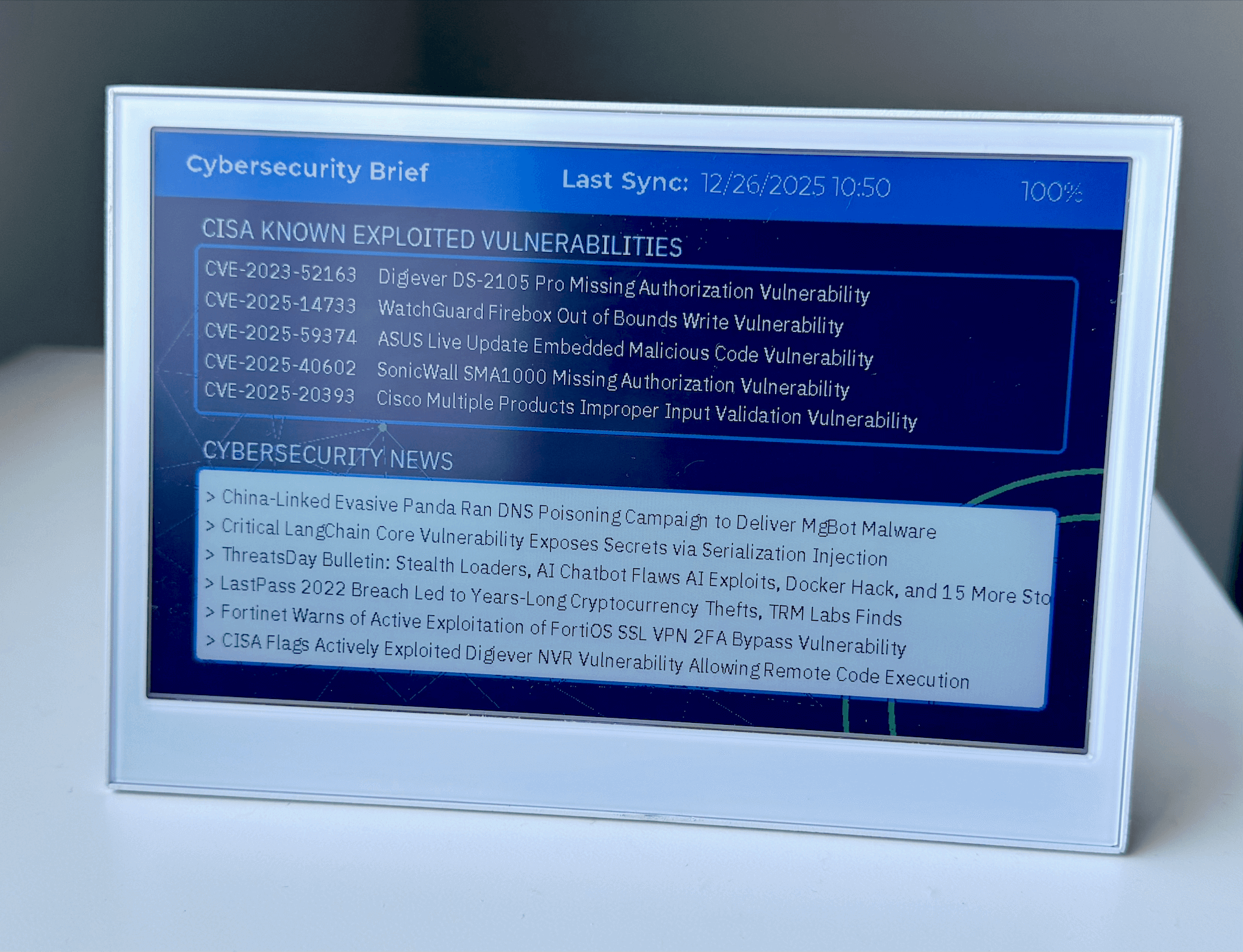
The intention is to deliver useful awareness at a glance, without browsers, notifications, or an always-on monitor. The display consumes virtually no power when idle, making it an ideal solution for continuous security awareness.
Why E-Ink Supports Sustainability
E-ink behaves more like paper than a traditional screen. Once text is drawn, it can stay visible without continuously powering pixels. That changes the energy story for a "desk dashboard":
- The display can remain readable all day without constant refresh.
- Power is spent mainly when information changes.
- The device can spend most of its time in low-power modes.
For a cybersecurity brief—where updates are valuable every few hours rather than every few seconds—e-ink is a practical sustainability choice.
A Simple Low-Energy Operating Pattern
The dashboard follows a straightforward rule: wake up only to do meaningful work.
- Content is refreshed every two hours.
- Wi-Fi is turned on only during the update window, then turned off again.
- Between updates, the system stays in low-power states and reduces activity.
- Updates are designed to finish quickly (no more than ~20 seconds), so the high-power window is brief.
This "short work / long rest" pattern is the core sustainability idea behind the build.
Battery Life: Theory and Practice
Exact battery life depends on many real-world factors—signal strength, network retries, firmware choices, and the efficiency of the power electronics. Any runtime statement should be treated as theoretical and described as a range, not a precise number.
That said, the design logic is clear:
- The device spends most of the day in very low power.
- A few times per day it briefly connects, downloads, updates the display, and returns to rest.
- With a 2000 mAh battery, this class of duty-cycled design commonly supports multi-month operation in theory, especially when updates are short and infrequent.
The key sustainability point is not the exact number of days—it's the approach: minimize wake time and avoid continuous display power.
Why Small Experiments Like This Matter
These projects are intentionally simple, but they reinforce an important principle: many digital habits assume "always-on" by default, even when it isn't necessary.
Low-power displays can help:
- Reduce the need for a dedicated always-on monitor or tablet.
- Lower background energy use by avoiding continuous refresh and constant connectivity.
- Encourage calmer, more intentional information consumption.
Cybersecurity awareness can be delivered in a way that is quiet, lightweight, and energy-conscious—and these small experiments are a practical way to explore that design space.
Practical Applications for Security Teams
Beyond the sustainability benefits, low-power security displays offer practical advantages for security operations:
- SOC wall displays: Show critical vulnerability alerts without running power-hungry monitors 24/7.
- Executive briefing boards: Provide at-a-glance security posture updates in meeting rooms.
- Remote site monitoring: Deploy battery-powered displays in locations without reliable power infrastructure.
- Compliance dashboards: Display key security metrics that update periodically rather than continuously.
Summary
This e-ink cybersecurity brief is part of ongoing experimentation around energy awareness and sustainability. By combining a low-power MCU, a display that holds an image without continuous power, and scheduled updates with Wi-Fi duty cycling, it demonstrates a simple idea:
Information can stay available without keeping a screen fully powered all day.
As organizations increasingly focus on reducing their environmental footprint, approaches like this show that even security operations can contribute to sustainability goals—one low-power display at a time.